



Reprinted from guessingheadlights.com with permission from the author. Originally published on October 15, 2026.
A Hibbing, Minnesota woman was arrested after deputies reportedly discovered methamphetamine in her purse during a traffic stop. The felony drug charge and accompanying DWI charge are relatively common, but an unusual observation buried in the paperwork attracted attention.
The woman had been searching for rocks along a gravel road near Hibbing when Deputy Cody Dillinger noticed her on October 3, 2026. He included an explanation in his search-warrant application for why the activity caught his attention.
John Ramos, publisher of the independent Duluth Monitor, discovered the passage while researching court records and shared it on Facebook, questioning the connection between rock collecting and illegal drug activity.
The post generated enough discussion to make the claim worth investigating. Behind the deputy’s unusual observation is a documented neurological phenomenon that helps explain why certain repetitive behaviors can sometimes accompany stimulant use.
A Curious Line in the Paperwork
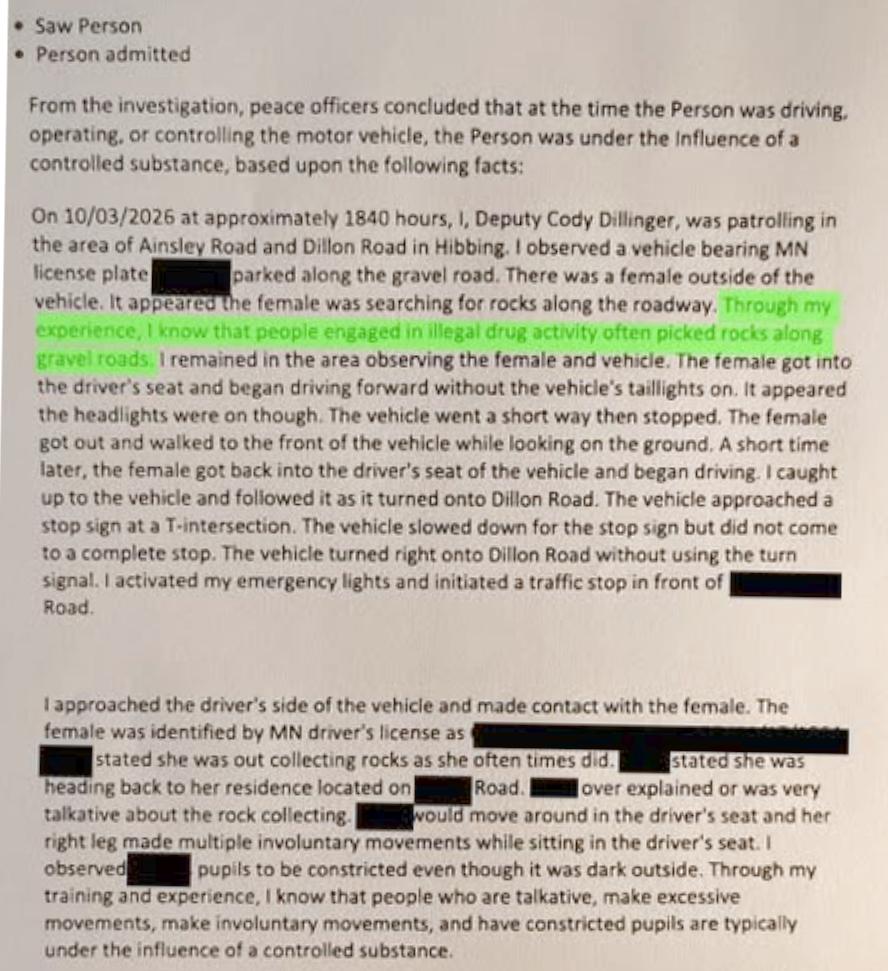
Dillinger was patrolling near Ainsley Road and Dillon Road at approximately 6:40 p.m. when he noticed 61-year-old Gena Margaret Partyka examining rocks outside a parked vehicle. In his search-warrant application, he wrote, “Through my experience, I know that people engaged in illegal drug activity often picked rocks along gravel roads.”
After Partyka returned to her vehicle, the deputy followed and observed that her headlights were on but her taillights were off. He reported that she rolled through a stop sign and turned without signaling, prompting him to initiate a traffic stop.
Partyka explained that she enjoyed collecting rocks as a hobby. During their conversation, Dillinger noticed involuntary movements, twitching, and constricted pupils that raised his suspicions about possible drug impairment.
He conducted field sobriety tests and reported that she struggled with several balance exercises, although she had disclosed previous knee injuries. The horizontal gaze nystagmus test showed no clues of impairment.
Another unusual exchange concerned a white film on Partyka’s tongue, which the deputy considered consistent with methamphetamine use. She attributed it to eating Smarties candy.
According to the October 5 criminal complaint, Partyka admitted taking three Adderall tablets without a prescription the previous day and said additional pills were in her vehicle. During a search, Dillinger found a pill bottle in her purse containing 5.6 grams of a white crystalline substance that field-tested positive for methamphetamine.
Prosecutors charged Partyka with felony fifth-degree drug possession and misdemeanor fourth-degree DWI involving a controlled substance. Blood-test results were pending when the complaint was filed. A $10,000 surety bond was posted on October 14, and her next court appearance is scheduled for October 21.
Why Rocks
The deputy’s observation has a possible connection to a neurological phenomenon called “punding,” which involves repetitive, intensely focused activities that can become difficult to interrupt.
Someone experiencing punding might spend hours sorting objects, repeatedly assembling and disassembling equipment, examining small items, or performing tasks that serve little practical purpose.
A medical review published in Psychiatric Clinics of North America describes punding among the neurological manifestations associated with chronic methamphetamine abuse. The phenomenon has also been documented in people with Parkinson’s disease taking medications that affect dopamine activity.
A 1999 paper published in Movement Disorders specifically mentions sorting and arranging pebbles, rocks, and other small objects as examples of punding. Researchers associate the behavior with changes in dopamine signaling, which helps regulate motivation, reward, and movement.
Punding can involve an unusual intensity of focus and repetitive activity, sometimes continuing for hours without a clear practical purpose.
Rock collecting, meanwhile, is a popular pastime in northern Minnesota, where Lake Superior agates attract enthusiasts. The medical literature does not establish that searching for rocks is a reliable indicator of drug use, and the court records do not establish that Partyka was experiencing punding.
The Discussion Took an Unexpected Turn
The Duluth Monitor’s Facebook post drew responses from people on both sides of the question.
Some longtime rock collectors described the suggestion as ridiculous, pointing to childhood hobbies, family collections, and years spent hunting agates without any connection to drugs.
Others described experiences that closely resembled the medical literature.
One commenter recalled a relative who used methamphetamine and spent hours collecting rocks, eventually accumulating so many inside a vehicle that they reportedly interfered with driving.
People describing their experiences in recovery offered another perspective. Some said they collected rocks during active addiction, while others said their interest in the hobby began or continued after becoming sober.
All parties are presumed innocent unless and until proven guilty in a court of law.