
In a closed-door contract discussion seven years ago, the Duluth School Board admitted it was counting on passage of a levy referendum to cover contract expenses. Class sizes were never significantly reduced after the referendum passed. Ballot referendums have often been bait-and-switch. After voters approved levy increases, big promises were tossed aside so the money could be diverted to cover the Duluth School Board’s profligate spending.
Even though the School District’s current tax levy is $48 million, they have placed two referendum questions on the November ballot, because they claim to be “nearing a financial crisis.”
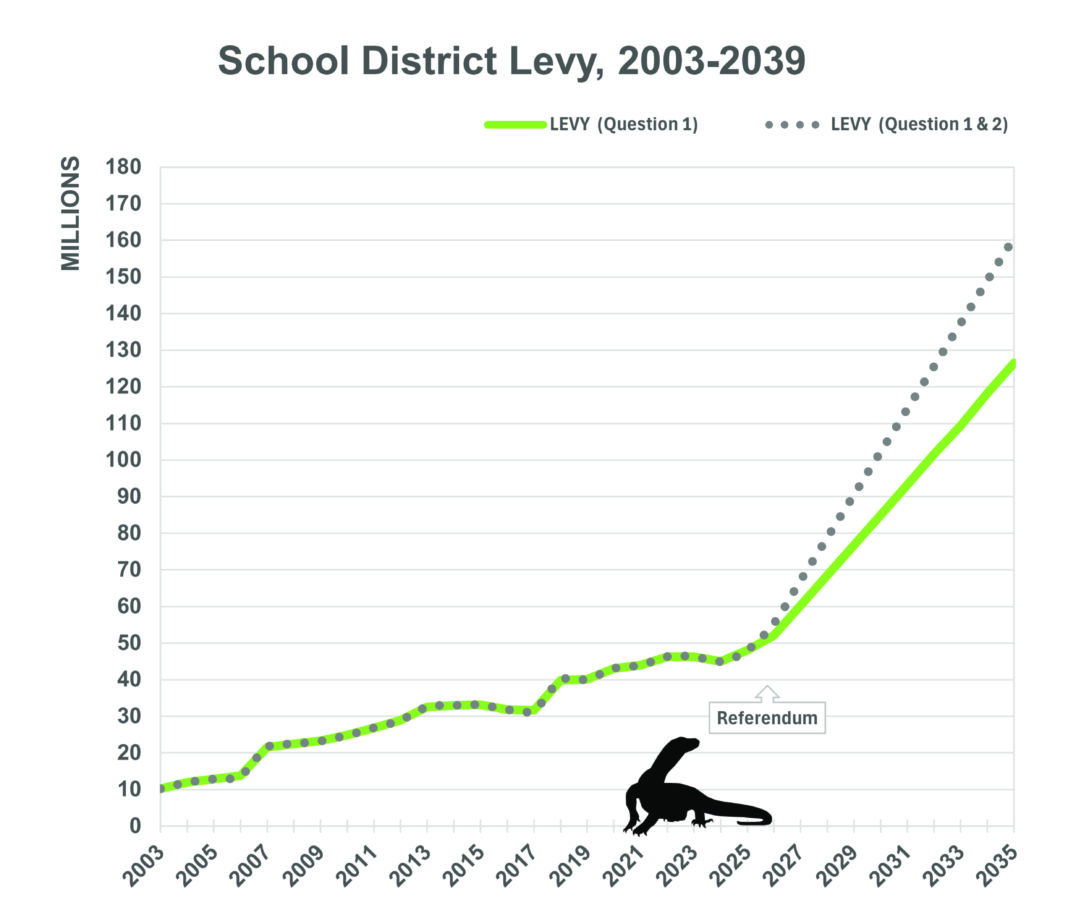
If Question 1 is approved, the levy will increase by $3.9 million in 2027, and then by $8.3 million per year through 2036. In total, voting Yes to Question 1 will increase the district tax levy by $78.1 million over the next ten years.
Question 2, which may only pass if Question 1 passes, would raise the levy by an additional $3.4 million per year for ten years (for a total of $34 million).
The School District levy was $8 million in 2003. If Question 1 of the referendum is approved, the levy will be approximately $52 million in 2027—a 550 percent increase in the past 24 years.
Inflation has increased by approximately 83 percent over the same period.
If both questions pass, the School District tax levy will increase by $112.1 million over the next ten years, for a total of more than $160 million by 2036. Taxpayers will actually be responsible for millions more than that, because annual inflationary increases are also built into the levies.
All this taxpayer largesse cannot promise to sustain the school’s operations through 2036. Because the referendum levy is an operating levy, which the School Board has the authority to renew without voter approval, the public will indubitably be asked to pay more. If approved, the 10-year levy will almost certainly morph into a 20-year levy. People in their 20s and 30s today will be in their 40s and 50s, paying off an ever-increasing levy into mid-century.
Money for nothing
The School District created this emerging crisis. When the District embarked on the Red Plan in 2008, without voter approval, many promises were made which have not come to pass. Proponents claimed that much of the half-billion-dollar plan’s cost would be covered by an increase in student enrollment, which would unlock more state funding. The predicted enrollment boost has yet to materialize. On the contrary, enrollment has remained stagnant. The district has about 8,300 students enrolled today—not 9,600, as optimistically projected by Red Plan supporters.
A large investment in facility maintenance will also be required over the next decade, as Red Plan buildings age. One of the four bonds already set to fall onto Duluth taxpayers is a $50 million maintenance bond (this includes interest). That bond will be the first installment of a tsunami of upcoming maintenance expenses.
This expense was predicted back in May of 2018, during the School Board’s Business Committee meeting. The District Facilities Manager clearly expressed what was coming: “It’s important for everyone to note that the Red Plan buildings were constructed between 2008 and 2013, and we’re now ten years out from the first buildings … We kind of have a grace period—another five or ten years—and once that hits, all the buildings will need work within a five-year period, and that’s going to be a huge number.”
As the end of the “grace period” nears, it will be a long time before taxpayers see any relief from this burden.

A man with a plan
In May of 2024, the school district’s attempt to take advantage of low voter turnout to pass a referendum backfired. Superintendent John Magas claims he placed the referendum question on a special election ballot because he wanted to minimize the amount of “noise” which traditionally surrounds regular elections. Unfortunately for Mr. Magas, having only one question out there, baldly asking for millions more of the voters’ tax dollars, captured everyone’s undivided attention. The low election participation appears to have made it easier for opponents to flip the script, because the referendum failed.
This time around, John Magas is hoping hot midterm races on this November’s ballot will draw a bigger, more sympathetic crowd to the polls. He may be right, because marginally interested citizens (most Duluth voters) will likely be distracted by all the other election “noise.”
The district craftily created a tiered referendum. Magas has learned from districts who have been successful in passing recent referendums. Placing two questions on the ballot allows voters to temper whatever ill will they are feeling toward the district and “split the baby” by approving only one of the two. John Magas structured the referendum questions so that citizens who want to vote “yes” on just one question have to pick the first one—the one which carries a significantly heavier taxpayer burden than the second.
John Magas isn’t just fighting for the school district. He’s fighting for his gig, his personal interests. Last spring, the Superintendent and other administrators received substantial salary increases from the board. Magas’ contract was increased by $26,000 (to $240,000) for the current 2026-27 school year, and was scheduled to increase by another $10,000 by 2028—boosting his annual salary to a quarter of a million dollars a year.
Bowing to public disapproval of this exorbitant pay, the superintendent recently announced that he was making a “personal sacrifice” and would forgo the extra $10,000 raise.
“I wanted to do that just to kind of model that we’re all having to tighten our belts,” Magas told reporters, as he bravely faced surviving on $240,000 per year.
Flat-footed in the last referendum, John Magas is geared up and on his toes for this one. He has been spending a lot of tax dollars to ensure a successful outcome. In addition to paying a hefty sum for a survey and mailings, the School Board approved a $42,150 contract with a public relations firm to promote the District’s message. The Super refuses to pinch pennies as we race to the finish.
Somebody’s gotta pay
Some years ago, as I was walking out of Old Central after a School Board meeting, I turned to the Board chair, who was walking nearby, and asked, “Have you ever looked at the district’s levy history?”
He shrugged and said, “No.”
I pointed out to him that, in the wake of the Red Plan, the school district’s property tax levy had increased by $20 million in a single decade. “At the rate things are going, I think it might hit $45, maybe even $50 million,” I said. “Doesn’t that bother you?”
He shrugged again and said, “Somebody’s gotta pay.”
The levy hit $45 million in 2023 and, if approved, the referendum questions on November’s ballot will push it beyond $50 million in 2027.
Usually you do “gotta pay,” Duluth. Usually, the school board takes your tax dollars without a vote. They would do it again if they could, but this time they have to ask. You can say no.
If you decide to say yes—obviously a good-hearted gesture—make sure you understand what you are saying yes to.